CC BY-SA 4.0 via Wiki (4 November 2022)
The saga of Twitter disruption continues this week. Twitter troubles. Whether you’re staying on the platform or considering moving to another service, this article is an excellent overview of distinctions and options.
If you’re active in digital social groups, does everyone pack up (all their shared messages and media) and move to Mastodon? Twitter refugees.
• PCWorld > “How Mastodon and federated services put social networks in the people’s hands” by Adam Taylor (Nov 30, 2022)
… Mastodon is missing all the profit-centric bloat of modern social media platforms. There’s no algorithm recommending you content or people to follow. Unlike Twitter or Facebook, where the goal is to keep you glued to the screen as much as possible and never leaving their website, Mastodon is just there to provide a social networking place for you to have conversations. … the point with Mastodon is to make friends, not follow brands.
Jargon
- Platform vs. service
- Federated vs. decentralized social networking service
- Peer-to-peer vs. community-run network
- Community instances
- Feeds
- Hashtags, handles, profiles
- Conversations, chats (and privacy)
- Timelines
- Posts – boosting, fav’ing
- Lists – pinning
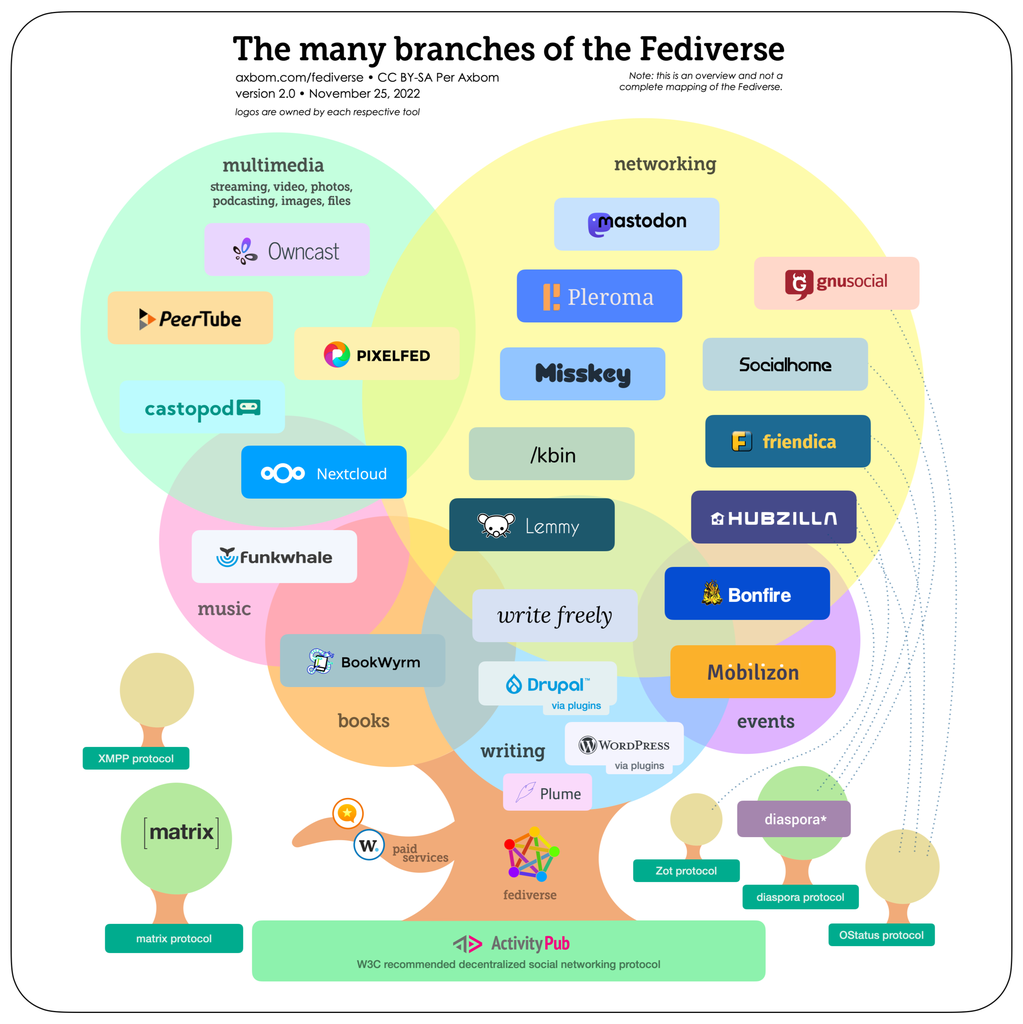
The Fediverse landscape
• Mastodon
Mastodon itself is very much a Twitter-like service. It’s a microblogging tool in which you send mostly short-form text posts, a few images or very small (40MB is the current limit) videos, build threads, follow and reply to other people, and “boost” (the equivalent of sharing or Retweeting) posts. There’s also messaging, though it’s not yet as fully developed as many might hope. You’d be forgiven for taking one glance at it and thinking “wow, that’s generic Twitter.” In a way, that’s the point.
Also mentioned (among others) in this article:
• PixelFed (“an Instagram clone”) – There are also no ads, no data selling, and no algorithms.
• PeerTube (videos)
• Owncast (host your own live streaming service, a Fediverse software platform)
• WriteFreely (a Fediverse software platform)
The cost of free on freedom
(quote) We can all benefit from a paradigm shift back away from users being the product, and towards gaining control over our online experiences. The internet used to be a fun place full of clubhouses run by people with varying interests, …