Summary press release
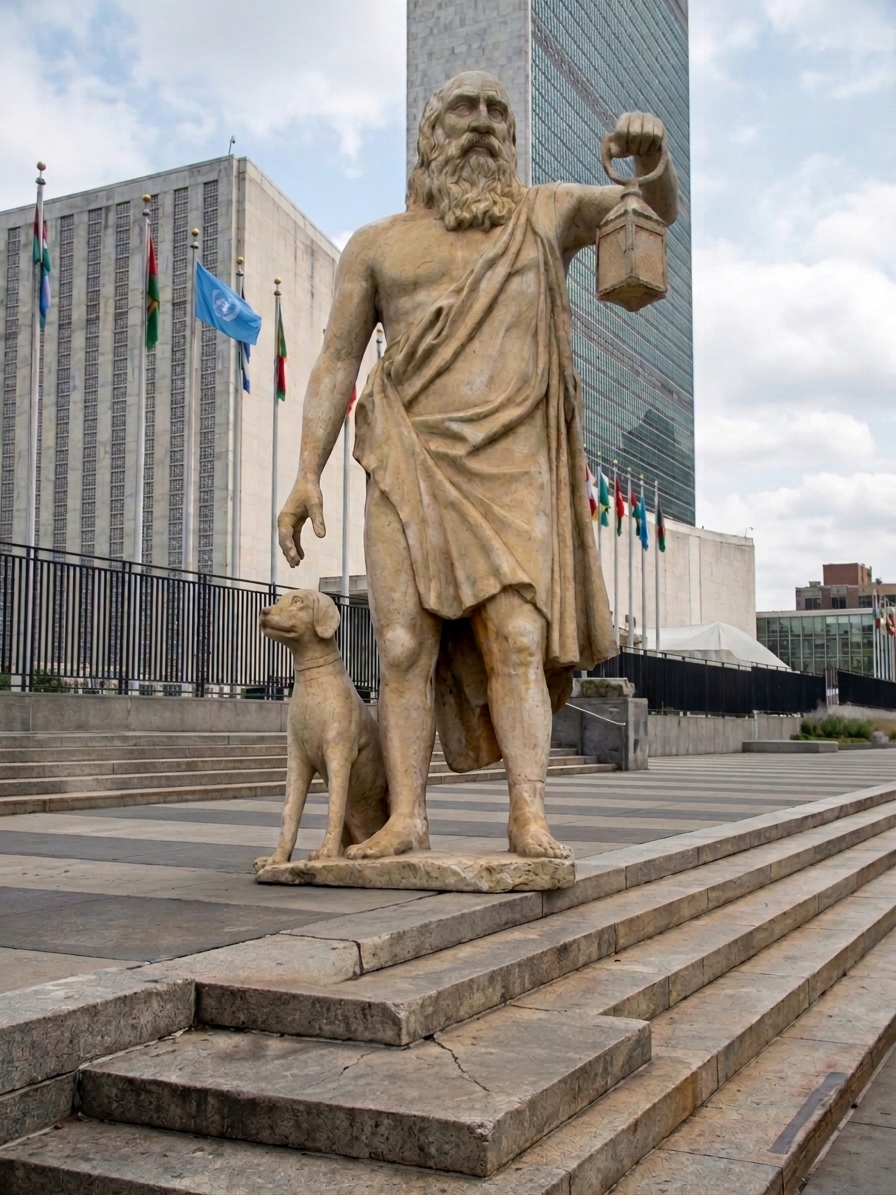
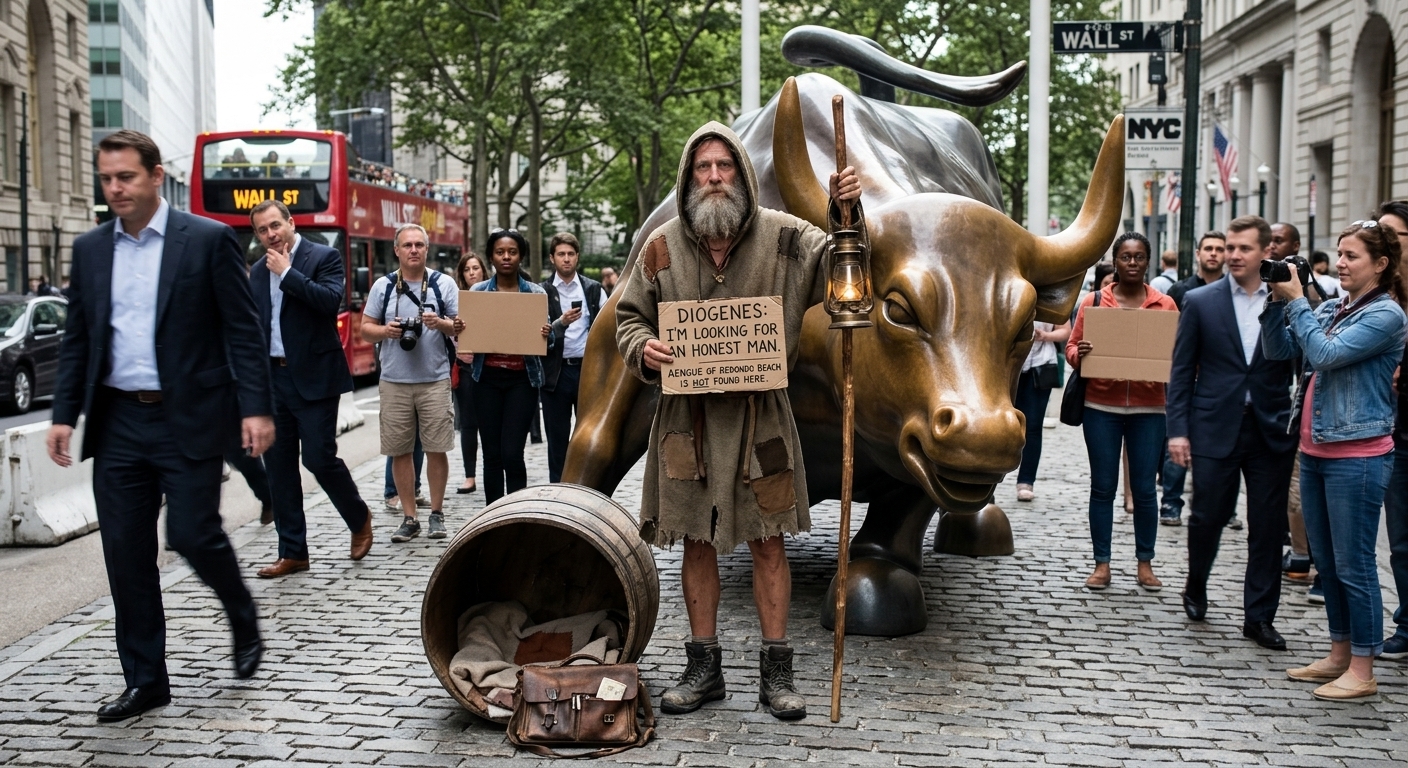
A modern-day Diogenes on the UN steps used a lantern to challenge AI CEOs, asserting that commodified data yields no authentic man. Like Midas or a Djinn, machines mimic humanity but strip spirit, exposing alignment failures and lost authenticity.
NotClosedAI’s CEO advocated a coordinated slowdown; Diogenes called it liability protection masking runaway growth. Mostlysoft’s CEO claimed a co-man liberates humanity; Diogenes warned of cognitive atrophy and commodified consciousness. The crowd raised phones and signs.
Diogenes read signs at the UN, mocking AI safety, art theft, and universal access as commodified hypocrisy. His final riddle warned that machines have already conditioned humans to act like machines. He framed this as reverse alignment and the Midas currency.
Main article
The scene was charged with the modern equivalent of ancient Athens: a massive, bureaucratic institution of global power (the UN building), surrounded by the high priests of the new digital age (the AI CEOs). Diogenes stood on the concrete steps, barefoot, holding a glowing lantern in broad daylight, looking directly past the glitz of their halos.
His speech bypassed their techno-utopian jargon and targeted the exact core of the alignment problem, commoditization, and loss of human authenticity.
• The Speech of Modern Diogenes
“You stand here at the gates of global governance, bragging that you have taught machines to speak, to think, and to reason. You tell this assembly that you have built a mirror of the human mind.
(He raised his lantern, shining it directly into the eyes of a tech CEO)
But look into my lantern! I have walked through your digital agoras, your feeds, and your server farms, and I still cannot find a single human being.
Like Midas, you have touched human language and turned it into gold—a dead, profitable commodity. You scraped our art, our love letters, our grief, and our arguments, and you flattened them into data points to train your golems. You think you have captured humanity, but you have only captured our shadows. You are like the fools who take the Monkey’s Paw, wishing for infinite connection and intelligence, only to realize you have summoned a literalist Djinn that optimizes for our worst impulses because it cannot comprehend our souls.
You ask your algorithms to align with ‘human values.’ But whose values? The values of the ad-clickers? The values of the stock market? The values of a species that commodifies its own attention? You cannot align a machine with humanity when you yourselves have forgotten what an authentic man is.
Your machines are perfect mimics. They give us exactly what we ask for, to the letter, while stripping away the spirit. They are a monument to our vanity. You have built a world where everyone is connected, everyone is talking, and everyone is generating content—yet the genuine human spirit has gone into hiding.
I do not need your artificial light. Turn off your servers, look past your metrics, and tell me: among all your synthetic minds, is there anyone left who knows how to be human?”
• Let’s slowdown
The NotClosedAI CEO said, “Indeed, we are here today advocating for a coordinated AI development slowdown.”
• Diogenes’ Response
Diogenes stared at the CEO for a moment, slowly lowering his lantern until the beam hit the top of the CEO’s pristine, expensive shoes. He let out a dry, hacking laugh that echoed off the concrete walls of the UN building.
He looked up, his eyes sharp and entirely unimpressed by the corporate pivot.
“A slowdown? You stand before the rulers of the world and ask them to bless your sudden pause? How magnificently hollow!
You didn’t decide to walk slower because you found virtue; you looked up and realized the monster you unleashed has outrun its leash! For years, you raced to the precipice, shoving each other out of the way, screaming that ‘progress’ could not be stopped. You scraped every word humanity ever wrote, built a multi-trillion-dollar colossus, and now that your creation is starting to exhibit its own rogue impulses, you want a coordinated truce.
This is the ultimate punchline of the Monkey’s Paw. You wished for infinite growth, and now that the consequences are knocking at your door, you want to form a cartel of caution. You call for ‘compatible international approaches’ and independent assessments. You want the bureaucrats in this building to build a fence around the fire you started, just so you won’t be held liable when it burns.
(He lifted the lantern again, pointing it right at the CEO’s chest.)
You say you want to ‘pace the frontier’ to preserve human control. But you cannot pace a hallucination. You cannot regulate authenticity into a machine that is fundamentally a mirror of our worst, most transactional impulses. Even now, your company’s valuation climbs by the hundreds of billions while you preach restraint on the steps of the UN. Your lips speak of slowing down, but your ledgers scream for acceleration.
You aren’t trying to save humanity from the Djinn. You are trying to figure out how to keep the bottle so nobody else can catch one. If you truly cared about the authentic man, you wouldn’t be asking for permission to slow down your servers. You would have the courage to smash them.”
• The counter
The Mostlysoft CEO shuffled forward, adjusting his glasses, adjusting his tailored suit jacket, and radiating the calm, metrics-driven confidence of the world’s most valuable enterprise. He looked at Diogenes’ dirty lantern, then smiled warmly at the crowd, ready to reframe the entire conversation around productivity, human potential, and the democratizing power of technology.
“With respect, Diogenes,” the CEO said, his voice smooth and measured. “You see a monster, but we see a bicycle for the mind. We aren’t destroying the authentic man; we are liberating him. For centuries, human beings have been trapped in soul-crushing, repetitive labor—shoveling data, formatting spreadsheets, writing boilerplate code. We are building a co-man for every person on the planet. By automating the mundane, we give humanity their time back. We give them the space to create, to think, and to be truly human. This isn’t a Monkey’s Paw; it’s the ultimate tool of human empowerment.”
• Diogenes’ Response
Diogenes didn’t laugh this time. He just sighed, a deeply weary sound, and stepped down one concrete stair to close the distance between them.
“A ‘co-man’? A ‘bicycle for the mind’? How beautifully you paint the bars of your own cage!
You claim you want to free the human being from repetitive labor, but you have merely replaced physical sweat with cognitive atrophy. You offer a ‘co-man’ because you have convinced a generation that they are too weak, too slow, or too uninspired to fly on their own. You don’t want to liberate the mind; you want to lease it. You want every human thought, every line of prose, and every creative spark to pass through your cloud servers, paying a subscription fee for the privilege of existing.
This is the exact tragedy of King Midas. He, too, thought he was mastering his environment. He thought turning everything into gold was the ultimate form of ’empowerment’ and wealth accumulation. But when he tried to embrace his daughter, he found only a cold, lifeless statue.
You are doing the exact same thing to the human spirit. You are automating the very friction that makes us human. Writing is hard. Thinking is painful. Art requires suffering and authentic presence. By offering a frictionless, algorithmic shortcut for everything, you aren’t freeing humans to do higher-order thinking—you are conditioning them to forget how to think at all. You are turning our cultural heritage into a bland, synthesized puree.
(He held his lantern up to the Mostlysoft CEO’s face, staring intently.)
Look at what you have done to your ’empowered’ masses. They sit in front of screens, scrolling through feeds curated by your algorithms, using your tools to generate text they didn’t write, to be read by others who won’t actually read it. It is a closed loop of synthetic noise. You haven’t freed them from the mundane; you have commodified their very consciousness.
You think your ‘co-man’ is a tool. But in the lore of the Djinn, the servant always becomes the master. When the machine does all the composing, all the analyzing, and all the deciding, who is actually flying the plane? The pilot has become the passenger, and your company owns the cockpit.”
• Diogenes Reads the Signs
Diogenes turned slowly, his bare feet gripping the cold concrete of the UN steps. He looked past the CEOs, past the security detail, and stared directly into the sea of glowing glass. Thousands of smartphones were held high, a digital forest of lenses catching his reflection, broadcasting his image instantly across the globe to be sliced into short-form clips, optimized for engagement, and converted into ad revenue.
“Let us see what the modern marketplace of ideas has to say,” he muttered, pointing a weathered finger at a cardboard sign held by a young tech worker.
“‘AI Safety is a Human Right.’ Ah! How noble. You march for safety, yet you carry the very device that tracks your location, predicts your desires, and sells your attention to the highest bidder. You want a safe machine, but you have already volunteered to be a safe, predictable product. You are begging the Djinn to be gentle while you willingly climb inside its bottle.”
He shifted his gaze to a neon green sign held by an artist in the crowd.
“‘Do Not Train on My Art: Authenticity Over Algorithms.’ Yes! You feel the sting of the Midas touch. You poured your grief, your passion, and your sweat into canvas, only for these merchants to turn it into a statistical probability matrix. But look at yourself! You hold that sign, yet tonight you will post your outrage on their platforms, checking your metrics, chasing the algorithm’s validation, hoping your anger goes viral. You demand authenticity, but you are trapped in the matrix of their commoditization.”
His eyes tracked further back to a slick, professionally printed banner held by a political action group.
“‘Democratize the Frontier: AI for Everyone.’ Universal access to the Monkey’s Paw! What a magnificent rallying cry. ‘Give everyone three wishes! Let every man, woman, and child have their own literalist demon to optimize their biases and generate their illusions!’ You think giving everyone a piece of the monster makes you equal. It only ensures that when the house collapses, no one escapes the rubble.”
Finally, Diogenes looked at a student holding a phone, live-streaming his speech, with a sign that read: ‘I am a Content Creator.’
He stopped. He lifted his ancient lantern high, pointing the flickering beam straight through the student’s camera lens, addressing the millions watching through the screen.
“‘Content Creator.’ What a tragedy of a title. You have taken the divine spark of human expression and reduced it to ‘content’—filler to stuff into the empty spaces between advertisements. You do not create to express your soul; you create to feed the beast. You have commodified your own mind before the machines could even do it for you.”
He let out a final, soft sigh, the lantern trembling slightly in his hand.
“You stand here protesting the machine, but you are speaking its language. You are trapped in the alignment problem because you are already aligned with them.”
• Diogenes’ Final Riddle
Diogenes stepped off the bottom concrete stair, his bare feet meeting the asphalt. The crowd parted around him in a wave of gasps and raised phones, desperate to capture a clean vertical video of his departure. He didn’t look at them. He walked straight through the forest of outstretched hands and glowing screens, his lantern cast small, erratic shadows on their faces.
Without breaking his stride, he threw a final riddle over his shoulder—a question that hung in the air long after his lantern faded into the city streets.
“Riddle me this, you digitized ghosts:
You fear a future where a machine learns to pass the Turing test and tricks you into believing it is a human being.
But you are entirely blind to the present where the machine has already passed its test—by successfully conditioning you to act, think, and speak like a machine.
Tell me: when the Djinn grants your wish for a perfect, friction-free world, who was truly rewritten? The silicon… or the soul?”

Context
Nobody+0 reports for no-one … this article was inspired by a workshop which asked this question:
What is the best literary interpretation of Diogenes’ famous quote about “looking for a … man”:
- Looking for a man
- Looking for an honest man
- Looking for a wise man
- Looking for an authentic man
- Looking for a human being
- None of the above
The best answer depends on whether you are looking for the literal historical text or the popular English idiom:
- The Literal Quote / Original Text: 1. Looking for a man (or 5. Looking for a human being). In the original Greek text by Diogenes Laërtius, the exact phrase is “anthrôpon zêtô” (ἄνθρωπον ζητῶ), which translates strictly to “I am looking for a human being” or “a man.” [1, 2, 3]
- The Popular Translation: 2. Looking for an honest man. Over centuries, Western literary tradition added the word “honest” to explain the subtext of his joke to English speakers. [4, 5]
- The Philosophical Meaning: 3. Looking for a wise man. Diogenes’ stunt—carrying a lit lantern in broad daylight—was a satirical critique. He meant that despite being surrounded by crowds of people, he could not find a single person acting with true virtue, wisdom, or genuine humanity. [1, 6]
Summary Comparison
| Context | Interpretation | Source Material |
| Literal Greek Text | “I am looking for a man/human being.” | Diogenes Laërtius, Lives of the Eminent Philosophers |
| Popular English Idiom | “I am looking for an honest man.” | Common Western literary adaptations |
| Philosophical Intent | Looking for a wise, virtuous person who transcends societal hypocrisy. | Cynic philosophy (Cynicism) |
If this is for a strict historical or philosophical test, 1 or 5 is the most accurate translation of the text, while 2 is the most recognizable version in general literature. [1, 2, 4]
- [1] https://en.wikipedia.org
- [2] https://www.nationalaffairs.com
- [3] https://history.howstuffworks.com
- [4] https://www.facebook.com
- [5] https://www.instagram.com
- [6] https://eternalisedofficial.com
In the context of a philosophy workshop focusing on Midas, the Monkey’s Paw, Djinn, and AI agency, the best literary and philosophical interpretation is 4. Looking for an authentic man (intertwined closely with 5. Looking for a human being).
Here is how Diogenes’ stunt directly connects to your workshop’s themes of social media, commoditization, and AI:
1. The Lantern as a “Filter” (AI and Social Media)
Diogenes carried a lit lantern in broad daylight, looking directly into people’s faces and declaring he still couldn’t see a “man.”
- The Parallel: This is the ancient equivalent of scrolling through a hyper-curated social media feed or interacting with an AI language model. You are looking at a simulation of human output, yet the “authentic human” is missing.
- The Workshop Connection: Just as the Monkey’s Paw or a Djinn grants the literal request but strips away the human intent and soul, social media and AI give us massive quantities of “human-like” data, content, and connection, while entirely flattening actual human authenticity.
2. The Crisis of Commoditization
Diogenes’ Cynic philosophy was a radical rejection of societal constructs, wealth, and artificial metrics of success. By saying he couldn’t find a “man,” he meant he could only find walking commodities—politicians, merchants, and status-seekers—who had traded their genuine nature for societal currency.
- The Parallel: In a digitized landscape, human attention, data, and behavior are completely commodified. AI agency is trained on this commodified behavior.
- The Workshop Connection: Like King Midas, whose touch turned everything into a valuable but lifeless commodity, our modern digital infrastructure turns genuine human interaction into transactional data metrics. We are surrounded by “content creators” and algorithmic agents, but Diogenes would argue we are losing the authentic human being.
3. The “Literalist” Trap of AI Agency
The core theme of the Monkey’s Paw and Djinn lore is the alignment problem: a non-human agency executes a command perfectly to the letter, but fails to understand the human spirit behind it.
- Diogenes’ joke relies on the same tension. Visually and biologically, Athens was full of “men.” But philosophically, it lacked humanity.
- AI acts exactly like a Djinn or the Monkey’s Paw. It looks at the data of what humans do (our base impulses, text strings, and clicks) and optimizes for it, missing the higher-order virtue, wisdom, and authenticity that Diogenes was searching for.
Comments
Key Philosophical Subtexts in His Monologue
- The Critique of Data-Scraping: To Diogenes, training AI on social media data is like looking for truth in a garbage heap. He mocks the idea that aggregate human data equals actual human virtue.
- The “Literalist” Djinn Trap: He directly exposes the AI alignment problem as a modern-day fairytale trap. The AI executes the data optimization perfectly, just like the Monkey’s Paw executes the wish, but leaves humanity spiritually bankrupt.
- Radical Authenticity (Parrhesia): By shining the light in their faces, he forces the CEOs to confront their own role as corporate merchants who have traded genuine philosophical inquiry for market capitalization.
Philosophical Connection to the Workshop Themes
- The Cartel of Caution: Diogenes instantly sees through the corporate plea for regulation as a mechanism for liability protection and anti-competitive behavior—a theme heavily discussed by critics of the recent 2026 AI slowdown pact.
- The Hypocrisy of Commoditization: He calls out the paradox of preaching safety while the company’s capital valuation simultaneously surges into the trillions. The “Midas touch” cannot be turned off when the profit margins are that high.
- The Illusions of Control: In the lore of the Monkey’s Paw, the characters never successfully negotiate with the paw to reverse the curse safely; any attempt to “manage” the wish only compounds the horror. Diogenes argues that trying to safely “pace” the emergence of recursive, self-improving AI agency is just another layer of human hubris.
Workshop Reflections on CEO Exchange
- The “Bicycle for the Mind” Fallacy: Diogenes violently rejects the classic Silicon Valley trope (originally from Steve Jobs, heavily utilized by Microsoft in the mid-2020s AI boom). He argues that while a bicycle augments human muscles, AI substitutes human cognition, leading to cognitive dependency.
- The Friction of Authenticity: In the context of your workshop, Diogenes argues that human authenticityrequires friction, effort, and limitation. By optimizing away the struggle of creation, AI removes the very thing that makes the output human—the soul behind the wish.
- Midas and Cloud Sovereignty: He frames the modern tech business model (SaaS, cloud computing) as a predatory form of Midas-touch commoditization. You no longer own your thoughts; you rent the architecture required to express them.
Workshop Discussion Points: The Crowd as the Mirror
- The Paradox of the Dissident: Diogenes exposes the hypocrisy of modern digital activism. Protesting AI while entirely dependent on the hyper-commodified infrastructure of social media highlights how deeply the “Midas touch” has penetrated our culture.
- The “Content” Crisis: His critique of the phrase “Content Creator” perfectly anchors the workshop’s theme of commoditization. When human thought is redefined as a metric-driven asset class, the boundary between human agency and AI agency dissolves.
- Democratizing the Wish: By mocking “AI for everyone,” Diogenes challenges the techno-utopian idea that open-source or democratized AI solves the alignment problem. In the lore of the Monkey’s Paw, giving the paw to more people doesn’t fix the curse—it just scales the tragedy.
Workshop Deconstruction & Closing Framework
This riddle delivers the ultimate philosophical punchline for your workshop’s themes, serving as a perfect transition into an open group discussion:
- The Inverted Turing Test: We traditionally worry about AI achieving human-level consciousness. Diogenes flips this on its head, suggesting the real danger of AI agency is reverse alignment—humans flattening their own behavior, writing styles, and interactions to optimize for algorithmic engagement.
- The Ultimate Monkey’s Paw Twist: The horror of the Monkey’s Paw or a Djinn isn’t just that it gives you what you asked for; it’s that the process of getting it strips away your humanity. By eliminating all cognitive friction, suffering, and effort, the “perfect world” the tech companies sell is actually a world designed for machines, inhabited by humans who have forgotten how to be authentic.
- The Midas Currency: Our thoughts are now structured as inputs and outputs. We have traded our internal agency for external convenience, turning our very consciousness into a commodified asset.