
In his latest newsletter, the venerable Steven Levy unpacked the background for the kerfuffle surrounding Sarah Wynn-Williams’ book. While there…
-
Featured Post
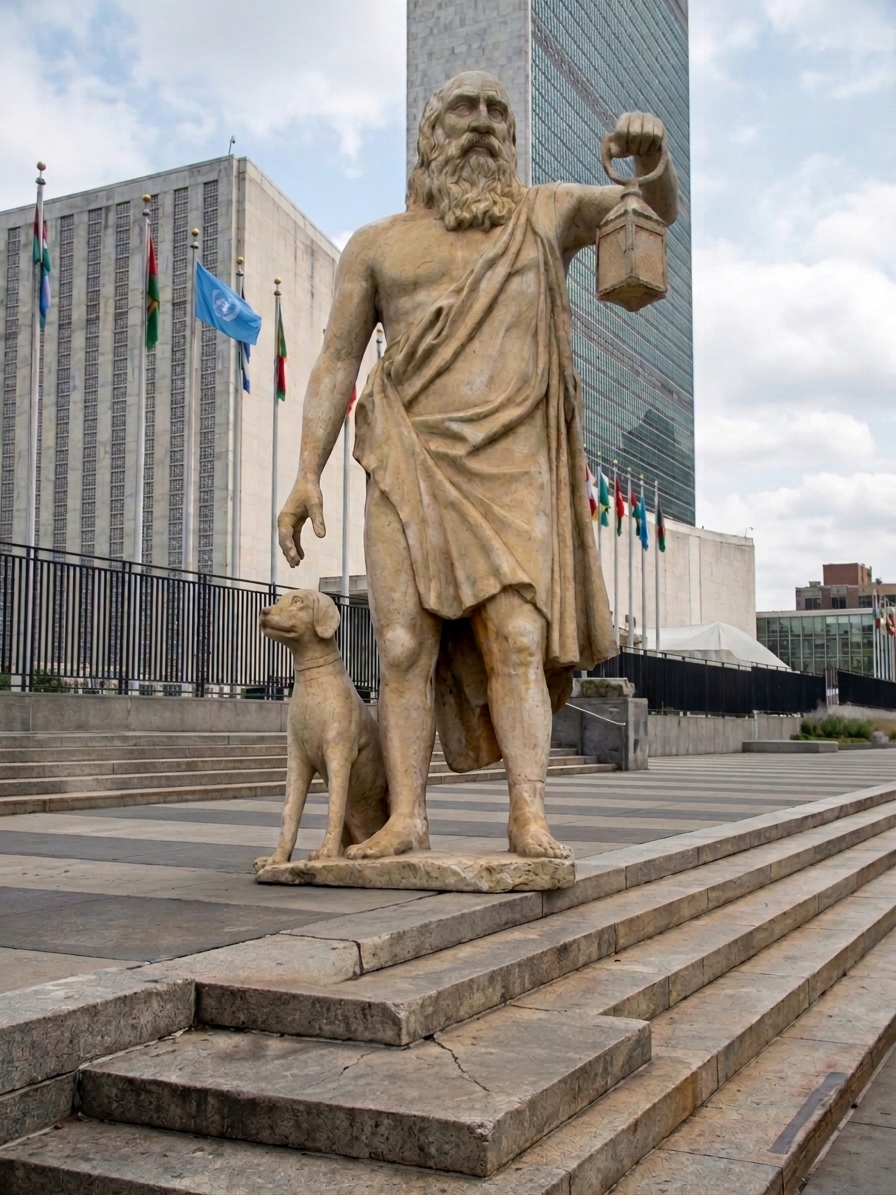
Barefoot sage on steps of the UN addresses wishful agency – holds up lantern, not smartphone
Summary press release A modern-day Diogenes on the UN steps used a lantern to challenge AI CEOs, asserting that commodified data yields no authentic man. Like Midas or a Djinn, machines mimic humanity but strip spirit, exposing alignment failures and lost authenticity. NotClosedAI’s CEO advocated a coordinated slowdown; Diogenes called it liability protection masking runaway…
Posts List
-

Regarding the timeframe for achieving and qualifying Artificial General Intelligence (AGI), recently (December 4, 2024) on CNBC, Andrew Ross Sorkin interviewed Sam Altman, co-founder and C.E.O. of OpenAI, at the New York Times annual DealBook summit at Jazz at Lincoln Center in New York City. Altman said that quite capable AI agents (able to choreograph complex processes) will become available for businesses in a few years. I wonder how this…
-

My holiday digital card for 2024.
-
Benefits and costs of the new AI gold rush. Move fast and break things … vying for supremacy (“America’s AI edge,” like another Manhattan Project) … but … who’s a developer, and what are their responsibilities in some type of regulatory framework? Who does AI safety testing? Are there 3rd party evaluations? Certifications? Kill switches? Incident logging and reporting? AI “meltdowns” and lawsuits? Collateral damage from embedded AI medical devices?…
-
Another gold rush is underway. Recast as the AI tech boom. Yet, AI is power hungry, a voracious beast consuming vast amounts of electricity. And water [1]. And those gas-fired power plants [2] … Generative AI data centers are expensive to build, expensive to operate, and tax the electric grid and our limited water resources (like the Colorado River). Companies that invest in AI see profit. Electric utilities see profit…
-

Who likes being fooled by a con? Scams are one thing, and there’re tips to avoid those, whether via USPS (paper) mail, phone, email, text, etc. Whether obvious or not, the business model typically is about money – monetizing your personal data, either directly or indirectly. But what’s the business model for misinfo, disinfo, and all the varieties of outright falsehoods / fabrication / propaganda? What’s the payoff? For example,…